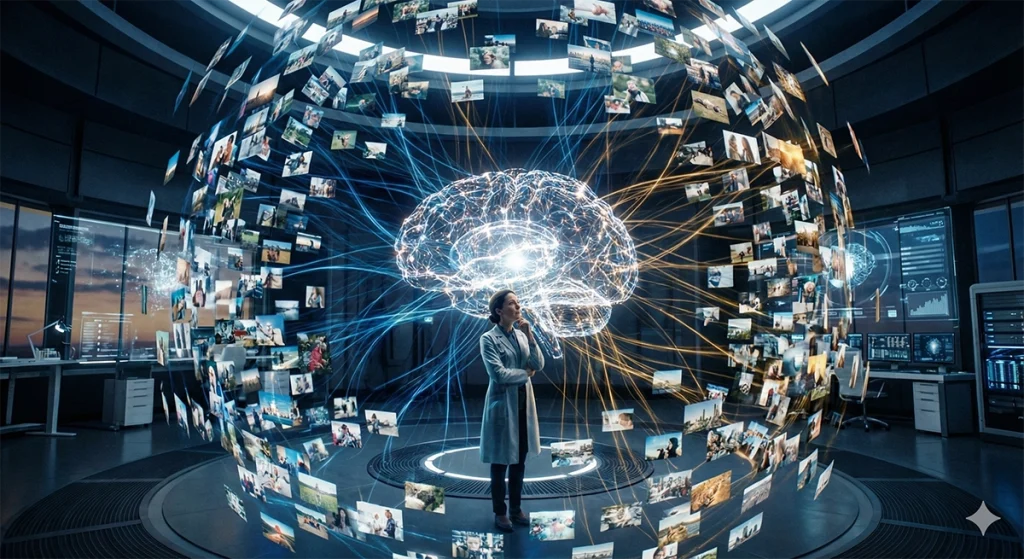
Behind every massive technological shift, there is a human story of persistence against the status quo. Today, as we witness the wonders of Generative AI and autonomous systems, it is easy to forget that the foundation they stand upon—ImageNet—was once considered a career-ending gamble by many in the academic community.
This article pays tribute to the visionaries who looked past the limitations of the mid-2000s and dared to believe that “the data would change the algorithm.”
1. The Architect: Dr. Fei-Fei Li
If ImageNet has a mother, it is undoubtedly Dr. Fei-Fei Li. In 2006, as a young assistant professor at Princeton (later moving to Stanford), Li observed a fundamental stagnation in Computer Vision. While her peers were focused on refining hand-coded algorithms to identify simple shapes, Li had a radical realization: the problem wasn’t the code; it was the world’s complexity.
A Career-Defining Risk
At the time, the academic world valued “smart” algorithms over “brute-force” data. Li was warned by senior colleagues that spending her time collecting images would hurt her chances of tenure. The prevailing sentiment was that “data collection is not science.” Yet, her intuition—informed by how human children learn through millions of visual stimuli—pushed her forward. She envisioned an Ontology of the visual world, a project so vast it was initially dismissed as impossible.
2. The Inner Circle: Jia Deng and Li Jia
A visionary leader needs a team capable of executing the impossible. Two of Li’s then-students, Jia Deng and Li Jia, played instrumental roles in the project’s success.
- Jia Deng: As a PhD student, Deng was a lead author on the original 2009 ImageNet paper. He was crucial in developing the mathematical frameworks for how to structure the massive hierarchy of images using WordNet. His work ensured that ImageNet was not just a collection of files, but a structured knowledge base.
- Li Jia: She brought a relentless work ethic to the logistical nightmare of data collection. Together with Fei-Fei Li, she faced the daunting task of sorting through millions of images without a clear way to verify their accuracy—until they discovered the potential of crowd-sourcing.
3. The Unlikely Ally: Amazon Mechanical Turk
While not a “person” in the traditional sense, the infrastructure of Amazon Mechanical Turk (MTurk) saved the project. In 2007, the ImageNet team was struggling to label images manually; at their current rate, it would have taken 19 years to complete the dataset.
The team’s decision to use MTurk was revolutionary. It was one of the first times a high-level scientific project utilized global “human-in-the-loop” computing at this scale. At the peak of production, the project became one of the largest employers on the MTurk platform, involving over 50,000 workers from 167 countries. This global effort democratized the “creation of intelligence.”
4. The Intellectual Foundation: George Miller and WordNet
The structure of ImageNet didn’t come from a vacuum. It was built upon the shoulders of George Miller, a pioneer in cognitive science and the creator of WordNet. WordNet was a hierarchical database of the English language that organized words into “synsets” (sets of synonyms).
Fei-Fei Li’s genius was in realizing that computer vision needed a visual counterpart to WordNet. By mapping images to Miller’s linguistic structure, the ImageNet team ensured that their dataset wasn’t just a random collection of photos, but a structured map of human concepts.
5. Overcoming the Skeptics
The road to the 2009 debut at CVPR (the premier computer vision conference) was paved with rejection. Early grant proposals were denied by the National Science Foundation (NSF) and other bodies. Critics argued that the dataset would be too noisy, too biased, or simply unnecessary for “real” AI research.
The visionaries behind ImageNet held a different view: they believed that by providing a Large-scale Dataset, they were providing the “ground truth” that would eventually allow machines to learn for themselves. They weren’t just building a database; they were building the “gymnasium” where AI would eventually learn to see.
6. The Legacy: From Princeton to the World
The project eventually migrated with Li to Stanford University, where it found the resources to launch the ILSVRC competition. The team’s commitment to making the data free and open-source was perhaps their most visionary act. By democratizing access to 14 million labeled images, they ensured that the AI revolution wouldn’t be confined to a single lab, but shared with the entire world.
Today, Fei-Fei Li is a global leader in Human-Centered AI, advocating for the ethical and inclusive development of the technology she helped spark. Her journey from a young immigrant in the U.S. to the “Godmother of AI” is a testament to the power of a single, unwavering vision.
7. Conclusion: The Human Element of Machine Intelligence
ImageNet reminds us that the most significant breakthroughs in Artificial Intelligence are often rooted in very human qualities: curiosity, stubbornness, and a deep appreciation for the complexity of the world. The visionaries behind ImageNet didn’t just give machines eyes; they gave the global research community a new way of thinking.
As we look toward the future of AI, we owe a debt of gratitude to those who, in 2006, saw a mountain of data and decided to start climbing.
References
- Fei-Fei Li: How we teach computers to understand pictures
- Stanford Vision and Learning Lab (SVL)
- Source: Stanford University
- URL: https://svl.stanford.edu/