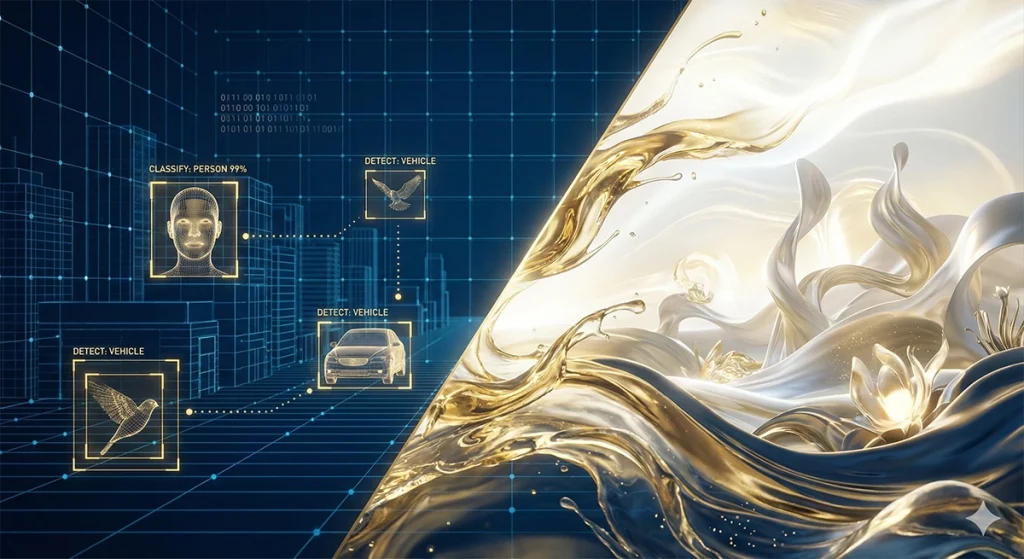
For more than a decade, the primary goal of Computer Vision was discrimination. We taught machines to distinguish a cat from a dog, a pedestrian from a lamp post, and a benign tumor from a malignant one. This was the era of “Recognition AI.” But recently, the industry has undergone a seismic shift. We are no longer just teaching machines to recognize the world; we are teaching them to create it.
The transition from recognition to generation marks the dawn of the Generative AI era. This article explores how the foundations of image recognition paved the way for models that can synthesize hyper-realistic images, art, and video from mere strings of text.
1. The Discriminative Foundation: Learning to See Before Learning to Paint
To create something, you must first understand its essence. Discriminative models (like the CNNs used in ImageNet competitions) learn the probability of a label $Y$ given an input $X$, denoted as $P(Y|X)$. Their job is to find the boundary between classes.
Generative models, on the other hand, attempt to learn the underlying probability distribution of the data itself, or $P(X)$. If a model understands the statistical distribution of “what makes a face look like a face,” it can then sample from that distribution to create a brand-new face that has never existed in reality.
The massive datasets of the recognition era, such as ImageNet, provided the “visual dictionary” that generative models needed to study before they could begin their own creative work.
2. The Pioneers: GANs and the Architecture of Competition
In 2014, Ian Goodfellow introduced Generative Adversarial Networks (GANs), and the world of AI was never the same. GANs operate on a brilliant concept of “mathematical friction” between two neural networks:
- The Generator: Tries to create a fake image.
- The Discriminator: Tries to detect if the image is real or fake.
As they compete, both get better. The Generator eventually becomes so skilled at mimicking the training data that the Discriminator can no longer tell the difference. This gave us the first wave of “Deepfakes” and hyper-realistic AI-generated portraits (e.g., StyleGAN). While groundbreaking, GANs were notoriously difficult to train and often lacked the diversity needed for complex scenes.
3. The Diffusion Revolution: Sculpting from Noise
While GANs were fighting, a new family of models was quietly evolving: Diffusion Models. Popularized by systems like Stable Diffusion, DALL-E, and Midjourney, these models take a completely different approach inspired by thermodynamics.
Instead of a competition, Diffusion models learn by reversing entropy:
- The Forward Process: A model takes a clear image and slowly adds Gaussian noise until it is unrecognizable.
- The Reverse Process: The model learns to “denoise” the image, effectively sculpting a high-resolution masterpiece out of a cloud of random digital static.
Because Diffusion models are more stable to train than GANs and can be guided by text (using CLIP embeddings), they have become the standard for modern creative AI.
4. The Bridge: Multi-modal Intelligence
The true “magic” of current generative models lies in their ability to bridge the gap between pixels and language. This is achieved through Multi-modal Learning.
By training on billions of image-caption pairs, models like GPT-4o or DALL-E 3 understand that the word “melancholy” has a specific visual representation—perhaps a blue-toned palette or a lone figure in the rain. This linguistic-visual mapping allows AI to translate human imagination into digital reality with unprecedented precision.
5. Beyond Images: The Future of World Models
We are now moving past static images into the realm of Video Generation and 3D World Models. Models like OpenAI’s Sora represent the next leap: understanding the laws of physics. To generate a video of a ball bouncing, the AI must not only know what a ball looks like but also how gravity, friction, and lighting interact over time.
This represents the ultimate evolution: from recognizing objects to simulating the very reality we inhabit.
Conclusion: The New Creative Turing Test
The rise of Generative AI doesn’t render Recognition AI obsolete; rather, it completes the circle of visual intelligence. Recognition provides the “what” and the “where,” while generation provides the “what if.”
As we inhabit this new era, the boundary between “human-made” and “AI-synthesized” is blurring. For sites like imagin.net, this transition is the fulfillment of a decade of research—showing that the journey that started with classifying pixels has led us to a future where we can manifest entire worlds from a single prompt.
References
- Generative Adversarial Networks (GANs)
- Source: NeurIPS 2014 (Ian Goodfellow et al.)
- URL: https://arxiv.org/abs/1406.2661
- Generative Models: OpenAI Research
- Source: OpenAI
- URL: https://openai.com/research/