The New Eyes of Medicine: From Pixels to Prescriptions
For centuries, medicine has relied on the trained human eye to spot the minute irregularities that signal disease. Whether it was a faint shadow on a physical X-ray film or a specific cell structure under a microscope, the accuracy of a diagnosis was often limited by human fatigue, cognitive bias, and the sheer volume of data.
The integration of Computer Vision (CV) into healthcare is changing this paradigm. By applying the same deep learning architectures that powered ImageNet—such as Convolutional Neural Networks (CNNs) and Vision Transformers (ViTs)—to medical data, we are providing clinicians with “superhuman” perception.
Today, Computer Vision is not just a research tool; it is a vital clinical partner, transforming healthcare from a reactive discipline into a predictive and highly precise science.
1. Radiology and Diagnostic Imaging: Beyond the Visible
Radiology is arguably the most advanced frontier for Medical AI. The ability of CV algorithms to analyze thousands of images in seconds has redefined the speed of triage.
- Oncology and Tumor Detection: AI models are now capable of identifying early-stage malignancies in lung CT scans and breast mammograms with accuracy rates that often match or exceed senior radiologists. By utilizing Semantic Segmentation, these models can delineate the exact boundaries of a tumor, aiding in precise radiation targeting.
- Cardiovascular Health: CV tools can automatically measure the volume of heart chambers and detect arterial blockages in cardiac MRIs, identifying risks of stroke or heart attack long before they become symptomatic.
- Emergency Triage: In cases of head trauma, AI can instantly flag intracranial hemorrhages (brain bleeds) in CT scans, ensuring that critical cases are moved to the top of a specialist’s review pile, saving precious minutes where every second counts.
2. Digital Pathology: The Cellular Revolution
Traditional pathology involves a specialist peering through a microscope at glass slides. Digital Pathology digitizes these slides at ultra-high resolution, allowing Computer Vision to perform “computational staining” and analysis.
- Automated Cell Counting: Identifying and counting specific types of cells (e.g., lymphocytes infiltrating a tumor) is a tedious task for humans but a perfect application for AI.
- Biomarker Identification: CV models can detect subtle patterns in tissue morphology that indicate a patient’s likely response to specific immunotherapies, enabling the era of Precision Medicine.
3. The Intelligent Operating Room: AI-Assisted Surgery
Computer Vision is increasingly moving from the diagnostic office into the operating theater.
- Surgical Navigation and AR: Using Augmented Reality (AR), AI can overlay a 3D “map” of a patient’s internal anatomy—such as the exact location of blood vessels or nerves—directly onto the surgeon’s view. This reduces the risk of accidental damage during complex procedures.
- Robotic Surgery: Systems like the Da Vinci robot are being enhanced with CV to provide “guardrails.” The AI can recognize specific surgical instruments and tissues, providing real-time feedback or even preventing the robot from moving into a “no-go” zone.
- Post-Operative Analytics: By analyzing video footage of surgeries, AI can help hospitals standardize “best practices” and identify areas where surgical techniques can be improved.
4. Remote Monitoring and Patient Care
Beyond the hospital walls, Vision AI is enabling a new era of proactive home care.
- Fall Detection: For the elderly, a fall can be life-threatening. Vision-based systems (often using privacy-preserving skeletal tracking) can detect a fall in real-time and alert emergency services without the need for wearable devices.
- Dermatology in Your Pocket: Smartphone-based AI apps can now analyze skin lesions to screen for melanoma. While not a replacement for a dermatologist, these tools act as an essential “first-line” screening mechanism for under-served populations.
- Vital Sign Estimation: Recent breakthroughs allow AI to estimate heart rate and oxygen saturation (SpO2) simply by analyzing subtle changes in facial skin color and blood flow patterns captured by a standard webcam.
5. Challenges: The Bridge Between Code and Clinic
Despite the immense potential, the “last mile” of medical AI implementation faces significant hurdles.
Data Privacy and Security
Medical data is governed by strict regulations like HIPAA (USA) and GDPR (EU). Training robust models requires massive datasets, but sharing patient images while maintaining anonymity is a complex technical and legal challenge.
The “Black Box” Problem
For a doctor to trust an AI’s diagnosis, they need to understand why the decision was made. This has led to the rise of Explainable AI (XAI), where models use “heatmaps” to show exactly which part of an X-ray led to a positive cancer finding.
Algorithmic Bias
As discussed in our previous article, bias in datasets can be lethal in medicine. If a dermatology AI is trained primarily on light-skinned individuals, its accuracy drops significantly for patients with darker skin tones. Ensuring diversity in medical datasets is a matter of life and death.
6. Conclusion: The Human-AI Partnership
The goal of Computer Vision in healthcare is not to replace the doctor, but to augment them. By removing the burden of repetitive tasks and providing deep insights from massive datasets, AI allows physicians to focus on what they do best: complex decision-making and empathetic patient care.
The journey from ImageNet’s generic object recognition to the highly specialized detection of a sub-millimeter tumor represents the true maturity of Artificial Intelligence. In the hands of healthcare professionals, Computer Vision has become more than just an algorithm—it has become a beacon of hope for a healthier future.
FAQ: Healthcare & Computer Vision
Q: Can Computer Vision diagnose diseases better than doctors? A: In some specific tasks, like spotting tiny nodules in lung scans, AI can be more consistent and faster. However, a diagnosis involves a holistic view of the patient’s history and symptoms, which still requires a human doctor’s judgment.
Q: Is my medical data safe if it’s used to train AI? A: Hospitals and AI companies use “De-identification” and “Federated Learning” techniques to ensure that personal identities are removed or that data never leaves the hospital’s secure servers during the training process.
Q: How does “Explainable AI” work in medicine? A: It often uses “Saliency Maps” to highlight the specific pixels in a medical image that influenced the AI’s decision, allowing the doctor to verify if the AI is looking at the actual pathology or just digital noise.
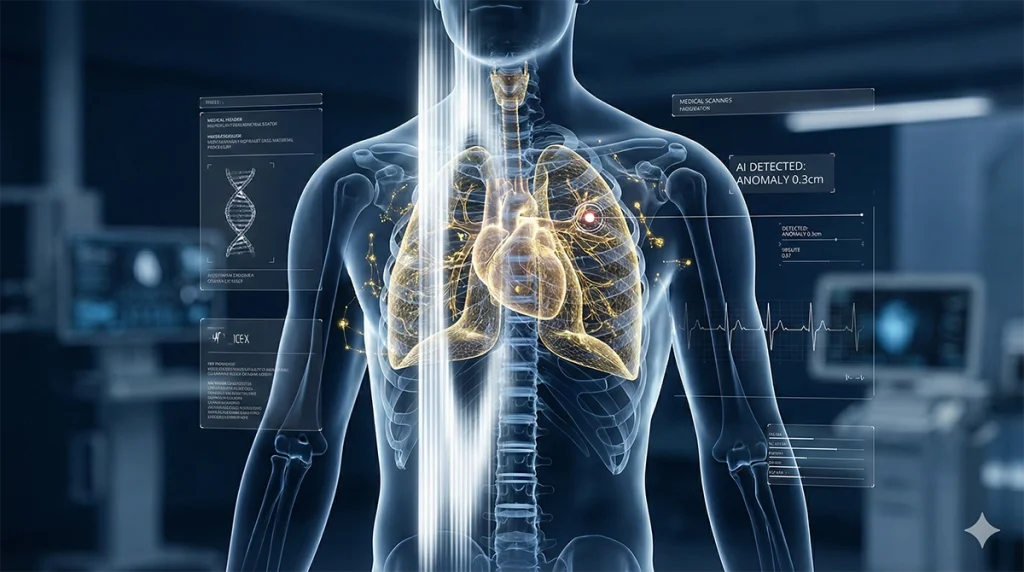
Visual Concept Suggestion: A high-tech, clinical visualization of a human torso or a specific organ (like the heart or lungs) being scanned by a series of glowing white and gold digital “slices.” The background is a clean, deep blue laboratory environment. Transparent AR overlays display medical metrics and “AI-detected” nodes in electric gold.
References
- A Guide to Deep Learning in Healthcare
- Source: Nature Medicine
- URL: https://www.nature.com/articles/s41591-018-0316-z
- Google Health: AI for Medical Imaging
- Source: Google Health
- URL: https://www.google.com/search?q=https://health.google/technologies/medical-imaging/