The Visual Revolution: From “Search” to “See”
For decades, the bridge between a consumer’s desire and a product was built on keywords. If you saw a beautiful lamp in a café, you had to guess its style, material, and brand, then type those descriptors into a search engine, hoping for a match. This linguistic barrier often led to friction, abandoned carts, and missed opportunities.
The rise of AI-Powered Image Analysis—a direct descendant of the large-scale classification benchmarks like ImageNet—has dismantled this barrier. We are moving from a “Search” economy to a “See” economy. In this new landscape, the smartphone camera is the new search bar, and pixels are more valuable than keywords.
From hyper-personalized online shopping to cashierless physical stores, Vision AI is rewriting the playbook for global commerce.
1. Visual Search: The “Snap and Find” Economy
Visual search is perhaps the most visible application of Computer Vision in E-commerce. By utilizing Deep Feature Extraction, AI can analyze an image and find visually similar items across a catalog of millions.
- Style Discovery: Platforms like Pinterest and Google Lens allow users to upload a photo and find identical or “style-similar” products. This is powered by Embeddings—mathematical representations of an object’s shape, color, and texture that allow the AI to find matches even if the lighting or angle differs from the original.
- Reducing Friction: Visual search shortens the path to purchase. A consumer no longer needs to know the name of a specific “Mid-century Modern Walnut Sideboard”; they simply need to see it, snap it, and buy it.
2. Virtual Try-Ons: Bridging the Digital-Physical Gap
One of the greatest hurdles for online fashion and beauty has always been the “uncertainty of fit.” Computer Vision is solving this through Augmented Reality (AR) and Generative AI.
- Virtual Fitting Rooms: Using Pose Estimation and 3D Body Mesh technology, apps can now overlay clothing onto a user’s live video feed. This allows customers to see how a garment drapes over their specific body shape, significantly reducing return rates—a multi-billion dollar problem for retailers.
- Beauty and Cosmetics: AI can accurately map facial features to apply virtual makeup, glasses, or hair colors. By analyzing skin tones and textures under different lighting conditions, these tools provide a level of realism that was impossible just five years ago.
3. The Future of Physical Retail: Autonomous Stores
The physical storefront is being reimagined as a “Sensor-Rich Environment.” The goal is to combine the data-rich insights of online shopping with the tactile experience of a brick-and-mortar store.
- Cashierless Shopping (Just Walk Out): Pioneered by Amazon Go, this technology uses a network of overhead cameras and Object Tracking to monitor which items a customer picks up and puts back. When the customer leaves the store, the AI automatically bills their account, eliminating the checkout line entirely.
- Automated Inventory Management: Robots equipped with Vision AI now roam aisles to perform shelf-audits. They detect “out-of-stock” items, misplaced products, and pricing errors with far greater frequency and accuracy than human staff, ensuring that the digital inventory always matches the physical reality.
4. Hyper-Personalization through Visual Intelligence
Traditional recommendation engines rely on “collaborative filtering” (people who bought X also bought Y). Vision AI adds a “content-based” layer that is far more intuitive.
- Visual Preference Profiles: By analyzing the images a user interacts with, AI can build a profile of their aesthetic taste—whether they prefer minimalist, brutalist, or bohemian designs.
- Dynamic Merchandising: E-commerce sites can now automatically re-rank search results based on a user’s visual history. If the AI knows you like “minimalist white sneakers,” it will prioritize those in your feed, even if they aren’t the top-selling items globally.
5. Supply Chain and Quality Control
Behind the scenes, Vision AI is optimizing the journey from factory to front door.
- Automated Sorting and Grading: In warehouses, AI identifies and sorts packages based on size, shape, and label information at speeds no human could match.
- Damage Detection: High-speed cameras analyze products on a conveyor belt to spot micro-cracks, dents, or packaging defects before they are shipped, protecting brand reputation and reducing waste.
6. Conclusion: The Rise of “Contextual Commerce”
The legacy of ImageNet was about teaching machines to name objects. The evolution of Retail AI is about teaching machines to understand Value and Intent.
As Computer Vision becomes more embedded in our lives, we are entering the era of Contextual Commerce. Shopping will no longer be a destination; it will be an integrated part of our visual experience. Whether you are walking down the street, watching a movie, or scrolling through social media, the ability to instantly identify and acquire what you see is becoming the new standard.
For retailers, the message is clear: the future of commerce is not just about having the best products, but about having the best “eyes” to connect those products with the people who want them.
FAQ: Retail & Vision AI
Q: How accurate is visual search compared to text search? A: In many cases, visual search is more accurate for “subjective” items like fashion or furniture, where the style is hard to put into words. AI can match patterns and shapes that keywords often miss.
Q: Does virtual try-on really look realistic? A: Yes, thanks to GANs (Generative Adversarial Networks) and diffusion models, modern virtual try-ons can simulate how light hits different fabrics and how makeup interacts with specific skin textures.
Q: Is “Just Walk Out” shopping private? A: While these stores use many cameras, they typically rely on “Skeleton Tracking” or anonymous ID tags rather than identifying individuals by their faces, ensuring a level of privacy while maintaining security.
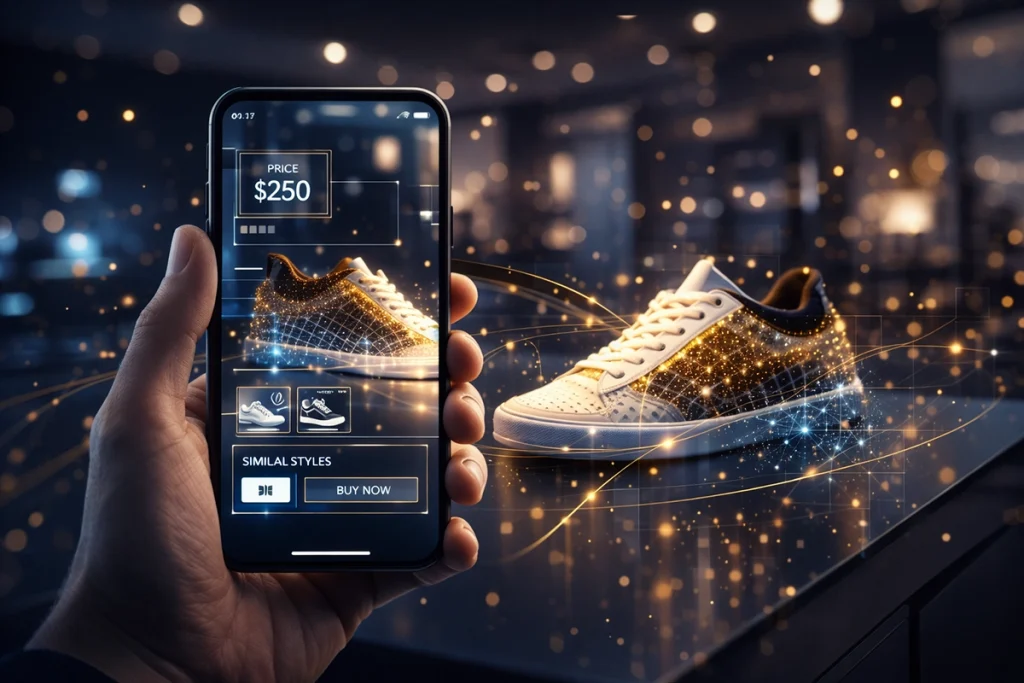
Visual Concept Suggestion: A vibrant, high-tech retail scene. A hand holds a smartphone, and the screen shows an augmented reality view of a luxury sneaker with golden digital data points, a “Buy Now” button, and price tags floating in the air. The background is a sophisticated boutique with deep blue lighting and electric gold accents on the shelves.
References
- Amazon Go: Just Walk Out Technology
- Source: Amazon Science
- URL: https://www.google.com/search?q=https://www.amazon.science/latest-news/computer-vision-algorithms-in-amazon-go
- Virtual Try-On Network (VITON)
- Source: CVPR 2018
- URL: https://arxiv.org/abs/1711.08447