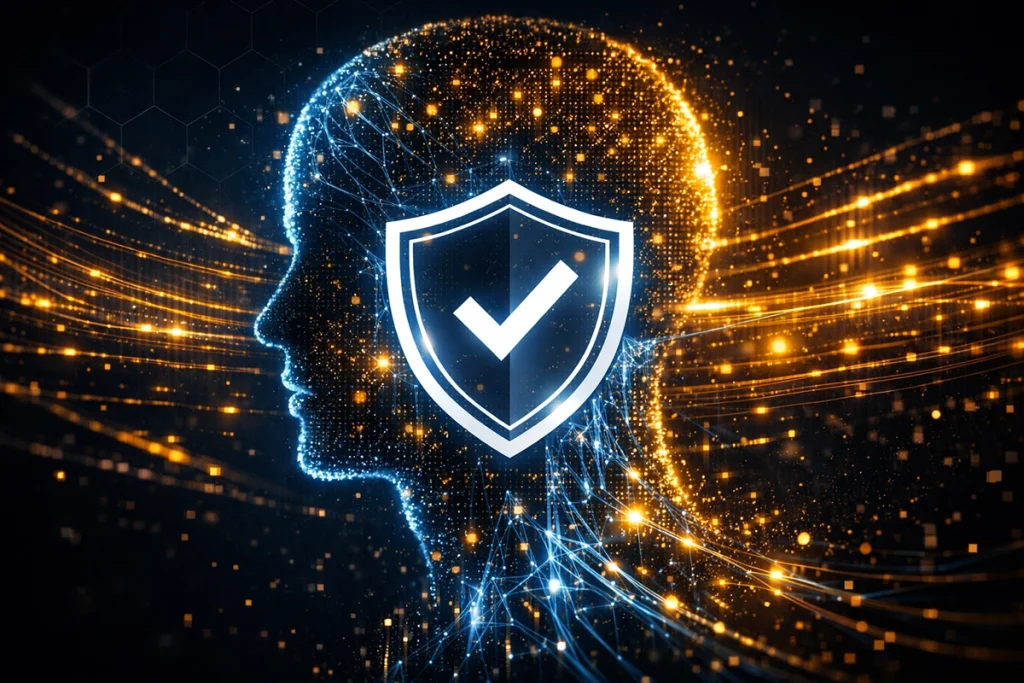
The Double-Edged Sword of Invisible Identity
In the physical world, our faces have always been our primary IDs. But in the digital age, Artificial Intelligence has transformed the human face from a simple biological feature into a sophisticated, searchable data point. This transition—powered by the same deep learning foundations that revolutionized ImageNet—has created a paradigm shift in both Digital Security and Public Surveillance.
AI-driven facial recognition and security systems offer a world of frictionless convenience: unlocking smartphones with a glance, securing borders without queues, and identifying cyber-threats at light speed. Yet, the same technology raises existential questions about the right to anonymity and the potential for state-sponsored overreach.
As we integrate Vision AI into the bedrock of our digital infrastructure, we must navigate the thin line between a “Secure Society” and a “Surveillance State.”
1. The Anatomy of AI-Driven Facial Recognition
The leap from early computer vision to modern Facial Recognition Technology (FRT) was fueled by the shift from manual feature engineering to Deep Neural Networks.
- From Landmark Points to Embeddings: Early systems measured the distance between eyes or the width of a nose. Modern AI creates a “faceprint”—a high-dimensional mathematical vector (embedding) that captures thousands of subtle patterns, making recognition possible even in low light, at sharp angles, or with partial obstructions like masks.
- Massive-Scale Training: The accuracy of FRT skyrocketed thanks to datasets vastly larger than the original ImageNet. By training on millions of diverse faces, models have achieved a level of precision that can distinguish between identical twins or track a single individual across a network of thousands of CCTV cameras.
2. Enhancing Digital Security: The Positive Frontier
AI’s impact on security extends far beyond just recognizing faces. It is fundamentally rewriting the rules of Cybersecurity and Access Control.
Biometric Authentication
Passwords are the weakest link in digital security. AI-powered biometrics—including face, iris, and even behavioral biometrics (how you type or hold your phone)—provide a much higher barrier against identity theft. Unlike a password, a biometric signature cannot be easily “phished.”
Real-Time Threat Detection
In cybersecurity, Vision AI is used to analyze patterns in network traffic or server room activity.
- Anomaly Detection: AI systems can “see” irregularities in data flows that suggest a breach is in progress, allowing for automated “kill-switch” responses before data is exfiltrated.
- Physical-Digital Convergence: In data centers, AI-monitored cameras can detect unauthorized physical access or even identify if a hardware component is overheating, merging physical safety with digital integrity.
3. The Shadow of Innovation: Risks and Ethical Concerns
With great power comes unprecedented risk. The “dark side” of AI in security manifests in three primary ways:
The Erosion of Anonymity
Facial recognition allows for “Passive Surveillance.” Unlike a fingerprint scan, which requires your cooperation, a camera can identify you from a distance without your knowledge or consent. In urban environments, this can lead to the “chilling effect,” where individuals alter their behavior because they feel constantly watched.
The Deepfake and Spoofing Menace
Generative AI has introduced a new vulnerability: Deepfakes. Attackers can now create realistic video or audio of a person to bypass biometric security or conduct “CEO fraud” via video calls.
- Liveness Detection: To counter this, security AI must now perform “liveness checks”—analyzing micro-movements of skin or eye reflections to ensure the “face” is a real person and not a high-definition screen or a digital mask.
Weaponized AI and Misidentification
If a facial recognition system is biased (as discussed in Article 16), misidentification can lead to wrongful arrests or denial of services. Furthermore, the potential for authoritarian regimes to use FRT to track and suppress political dissidents is a major global concern.
4. Regulation and the Future of Trust
How do we harness the security benefits of AI without sacrificing our civil liberties? The answer lies in Governance and Privacy-Enhancing Technologies (PETs).
- The EU AI Act and GDPR: Europe is leading the way with strict regulations. The AI Act classifies most public facial recognition as “high-risk,” requiring transparency, human oversight, and in many cases, outright bans for mass surveillance.
- On-Device Processing: To protect privacy, many tech companies are moving toward “Edge AI.” Instead of sending your faceprint to a central server, the AI processing happens entirely on your local device (e.g., Apple’s FaceID), ensuring your biometric data never leaves your possession.
- Red Teaming for Security: Security firms are increasingly using “Adversarial AI” to test their own systems—trying to trick their facial recognition models to find vulnerabilities before malicious actors do.
5. Conclusion: Building a Secure and Ethical Future
AI has made the world more secure, but it has also made the concept of “private life” more fragile. The challenge for the next decade is not just to make facial recognition more accurate, but to make it more accountable.
As heirs to the ImageNet legacy, we must remember that the data we collect and the models we build have real-world consequences. Digital security should be a shield that protects us, not a spotlight that exposes our every move. By combining robust engineering with rigorous ethical frameworks, we can create a digital world that is both safe and free.
FAQ: Digital Security & Facial Recognition
Q: Is facial recognition data stored as a photo? A: No. Most professional systems convert the image into a mathematical hash or vector called a “faceprint.” This cannot be converted back into a recognizable photo of your face if the data is stolen.
Q: Can a high-resolution photo trick AI facial recognition? A: Modern systems use “Depth Sensing” and “Liveness Detection” to ensure they are looking at a 3D living person rather than a 2D image or a screen.
Q: What is “Behavioral Biometrics”? A: It is a security layer that analyzes how you interact with a device—such as your typing rhythm, gait, or the angle you hold your phone—to verify your identity continuously, even after you have logged in.
Visual Concept Suggestion: A high-tech, cinematic split-screen composition. One side shows a clean, white “Security Shield” icon composed of digital nodes. The other side shows a stylized human face rendered in electric gold wireframes, with scanning lines passing over it. The background is a sophisticated deep blue network grid. The contrast represents the balance between protection (shield) and perception (face recognition).
References
- Face Recognition Vendor Test (FRVT)
- Source: NIST (National Institute of Standards and Technology)
- URL: https://www.nist.gov/programs-projects/face-recognition-vendor-test-frvt
- Explaining and Harnessing Adversarial Examples
- Source: ICLR 2015
- URL: https://arxiv.org/abs/1412.6572