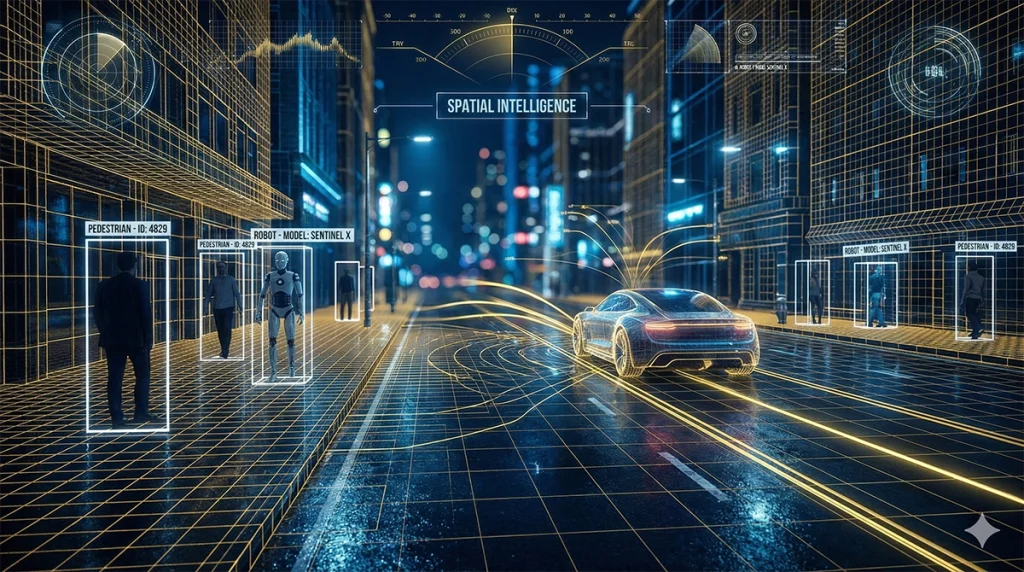
From Passive Recognition to Active Navigation
For the first decade of the Deep Learning revolution, Vision AI was largely a passive observer. It was trained to look at a static image and declare, with varying degrees of certainty, “This is a stop sign” or “This is a pedestrian.” While revolutionary, this was a form of intelligence detached from the physical world.
Today, we are witnessing the Great Transition. Vision AI has moved from Passive Recognition to Active Navigation. In the realms of autonomous vehicles and advanced robotics, “seeing” is no longer just about labeling pixels—it is about understanding the 3D geometry of space, predicting the physics of motion, and making split-second decisions that involve life and limb.
This is the dawn of Spatial Intelligence, the bridge between digital perception and physical action.
1. Vision AI in the Driver’s Seat: The Quest for Level 5 Autonomy
The automotive industry has become the primary laboratory for high-stakes Vision AI. The dream of a car that requires no human intervention (SAE Level 5) rests almost entirely on the shoulders of computer vision.
The Great Debate: Sensor Fusion vs. Vision-Only
There are two dominant philosophies in the autonomous driving world:
- Sensor Fusion (Waymo, Cruise): This approach combines Vision AI with LiDAR (Light Detection and Ranging) and Radar. LiDAR provides a precise 3D map of the environment, acting as a safety net for the visual cameras.
- Vision-Only (Tesla): Championed by Elon Musk, this philosophy argues that since humans drive using only vision and a biological neural network, a sufficiently advanced artificial neural network should do the same. This relies on Occupancy Networks—AI that predicts the volume of space occupied by objects in real-time without needing expensive laser sensors.
Beyond Object Detection: Path Prediction
Modern self-driving systems don’t just see a cyclist; they predict the cyclist’s intent. By analyzing subtle cues—a head tilt, a slight wobble, or the proximity to an intersection—Vision AI models now perform Temporal Sequence Modeling. They treat the world as a video stream rather than a series of photos, allowing them to anticipate movement before it happens.
2. The Robotic Renaissance: From Factories to Living Rooms
While cars are essentially “robots on wheels,” the field of general robotics is seeing an even more radical transformation through Vision AI.
The Rise of Humanoid Robots
Companies like Boston Dynamics, Figure, and Tesla (Optimus) are developing humanoids designed to navigate environments built for humans. This requires a level of visual processing far beyond traditional industrial robots.
- Semantic Navigation: A robot must not only see a “door” but understand that a handle is the mechanism to open it.
- Hand-Eye Coordination: Vision AI is now integrated with Reinforcement Learning to enable robots to perform delicate tasks, like folding laundry or sorting components in a messy warehouse, by adjusting their grip based on real-time visual feedback.
Spatial Computing and SLAM
Simultaneous Localization and Mapping (SLAM) has evolved. Modern robots use Vision-based SLAM to build 3D semantic maps of their surroundings. They don’t just know where they are; they know what the objects around them are and how they can interact with them.
3. The Challenge of the “Long Tail” and Edge Cases
The final 1% of autonomy is harder than the first 99%. This is known as the Long Tail of Edge Cases—unpredictable scenarios that AI has never encountered in its training data.
- Environmental Extremes: Heavy snow, blinding glare, or “ghosting” on wet pavement can confuse even the best Vision AI.
- Human Unpredictability: A person wearing a T-shirt with a “STOP” sign printed on it, or a child wearing a dinosaur costume, represents a catastrophic failure point for traditional classifiers.
- Ethical Decision Making: In a split-second collision scenario, how should the Vision AI prioritize safety? These “Trolley Problem” scenarios remain a hurdle for legal and social acceptance.
4. Hardware at the Edge: The Silicon Behind the Vision
The future of autonomous systems isn’t just in the algorithms; it’s in the silicon. Processing high-resolution video streams in real-time requires massive computational power with near-zero latency.
We are seeing a shift toward Edge AI. Instead of sending data to the cloud, autonomous systems use dedicated NPUs (Neural Processing Units) and customized chips (like Tesla’s FSD chip or NVIDIA’s DRIVE platform) to process vision locally. This “on-device” intelligence ensures that a car or robot can react in milliseconds, even without an internet connection.
5. Conclusion: Toward Embodied Intelligence
The legacy of ImageNet provided the vocabulary for AI. Now, autonomous systems are providing the grammar and the action. We are moving toward a future of Embodied AI—intelligence that is not confined to a screen but is integrated into a physical form that can move, touch, and change the world.
Whether it is a car navigating a rainy highway or a humanoid assistant helping in a hospital, the core of this revolution is Vision AI. By teaching machines not just to see, but to understand the consequences of what they see, we are closing the gap between artificial and human intelligence.
FAQ: Autonomous Systems & Vision AI
Q: Why is LiDAR still used if Vision AI is so advanced? A: LiDAR provides direct, active 3D measurements regardless of lighting conditions, acting as a redundant safety layer that compensates for the potential optical illusions or “hallucinations” of Vision AI.
Q: What is “Spatial Intelligence”? A: It is the ability of an AI to understand the 3D relationships, physics, and semantics of objects in a physical environment, allowing it to interact with the world rather than just observing it.
Q: Can Vision AI ever be 100% safe in driving? A: While no system is 100% safe (including human drivers), the goal is to be significantly safer than humans by processing 360-degree data faster and without distractions like fatigue or emotion.
Visual Concept Suggestion: A futuristic perspective shot from a car’s dashboard or a robot’s “eyes.” The world is rendered as a mix of high-fidelity reality and digital overlays (bounding boxes, 3D wireframes of the road, heatmaps of predicted motion). Colors: Deep blue night scene, electric gold highlights on detected objects, and clean white digital UI elements.
References
- End-to-End Driving with Semantic Neuro-Control
- Source: Waymo Research
- URL: https://waymo.com/research/
- Tesla AI & Robotics
- Source: Tesla AI
- URL: https://www.tesla.com/AI