The Sensory Evolution of Artificial Intelligence
For decades, Artificial Intelligence operated in silos. Computer Vision models were masters of pixels but deaf to words; Natural Language Processing (NLP) models could compose poetry but were blind to the world they described. This “unimodal” approach mirrored a fragmented form of intelligence—one that lacked the holistic understanding inherent to human experience.
We do not perceive the world through a single lens. When we see a video of a crackling fireplace, our brains naturally integrate the visual flicker of orange flames, the rhythmic snapping sound of wood, and the linguistic concept of “warmth.” For AI to reach its next milestone, it had to break the barriers between these data types.
Multimodal AI is the realization of this sensory integration. By synthesizing vision, text, and audio into a unified computational framework, we are moving beyond simple pattern recognition toward a more profound, “embodied” form of machine intelligence.
1. From CLIP to GPT-4o: The Architecture of Integration
The breakthrough in multimodality didn’t happen overnight. It was catalyzed by the realization that different forms of data could be mapped into a Shared Latent Space.
The Role of Contrastive Learning
One of the most significant pivots was OpenAI’s CLIP (Contrastive Language-Image Pre-training). Instead of teaching a model to recognize a “cat” by looking at millions of labeled images, CLIP was trained to predict which caption goes with which image. This created a bridge: the model learned that the visual representation of a feline and the textual token “cat” occupy the same semantic neighborhood in its mathematical “brain.”
The Transformer as a Universal Processor
The rise of the Transformer architecture acted as the “Universal Translator.” Because Transformers treat data—whether pixels, phonemes, or words—as sequences of tokens, they provided a common language for fusion.
- Vision Transformers (ViT): Slice images into patches, treating them like words in a sentence.
- Audio Transformers: Process spectrograms as temporal sequences.
- Cross-Attention Mechanisms: Allow the model to “attend” to a specific part of an image while processing a specific word in a text string.
The Rise of Native Multimodality
Unlike earlier “Frankenstein” models that stitched separate encoders together, the newest generation—such as GPT-4o or Gemini 1.5 Pro—is trained natively across modalities. They don’t translate images into text before understanding them; they “see” and “hear” directly within the same neural network layers.
2. Breaking the Barriers: Why Multimodality Matters
The transition from unimodal to multimodal AI is not just a technical upgrade; it is a fundamental shift in how machines interact with human reality.
- Contextual Understanding: A unimodal vision system might see a “red light,” but a multimodal system understands the command “Stop!” when it sees that light, hears a siren, and reads a “Road Closed” sign simultaneously.
- Enhanced Robustness: If one sensory input is noisy (e.g., blurry video), the AI can rely on audio cues or textual metadata to maintain accuracy.
- Generative Synergy: This is the engine behind tools like Sora. These models don’t just “draw”; they translate complex linguistic nuances into high-fidelity visual structures by understanding the deep relationship between descriptions and shapes.
3. Real-World Applications: Intelligence in Action
The integration of vision, text, and audio is already transforming industries by enabling deliberate and multifaceted reasoning.
Next-Generation Virtual Assistants
Move over, basic voice command systems. The future belongs to assistants that can see your broken appliance through a smartphone camera, listen to the rattling sound it makes, and read the digital manual in real-time to guide you through a repair.
Autonomous Systems and Robotics
For a robot to navigate a crowded hospital, it must interpret visual depth (Vision), understand verbal instructions from doctors (Text/Audio), and perhaps even sense the urgency in a person’s tone of voice. Multimodality is the prerequisite for True Autonomy.
Healthcare Diagnostics
Multimodal models can aggregate MRI scans (Vision), patient history (Text), and heart-rate sonograms (Audio) to provide a holistic diagnosis that no single-specialty AI could achieve.
4. The Challenges of “Unified” Intelligence
Despite the rapid progress, creating a truly seamless multimodal brain remains one of the hardest problems in AI research.
- Data Alignment: Finding massive datasets where vision, audio, and text are perfectly synchronized is difficult. While the internet provides “alt-text” for images, high-quality “aligned” video-audio-text data is scarce.
- Computational Intensity: Training models that process multiple streams of high-bandwidth data (like 4K video) requires astronomical amounts of GPU power and optimized memory management.
- The “Hallucination” Multiplier: When a model misinterprets a visual cue, it can lead to a “textual” hallucination that feels incredibly convincing, making the stakes for accuracy much higher.
5. Conclusion: Toward Embodied AI
The legacy of ImageNet taught us how to label the world. The era of Multimodal AI is teaching us how to understand it. By integrating the three pillars of human communication—what we see, what we say, and what we hear—we are building machines that no longer feel like calculators, but like partners.
As we look toward the future, the goal is Embodied AI: intelligence that can perceive and act within a physical environment just as a human does. We are no longer just teaching machines to see; we are teaching them to experience.
FAQ: Multimodal AI Section
Q: What is the difference between Multimodal AI and standard AI? A: Standard (unimodal) AI processes one type of data, like text or images. Multimodal AI can process and relate multiple types (e.g., seeing an image and describing it in text) simultaneously.
Q: Is GPT-4o a multimodal model? A: Yes, GPT-4o (“o” for Omni) is natively multimodal, meaning it can process and generate text, audio, and images in real-time within a single model.
Q: How does multimodal AI help in robotics? A: It allows robots to understand verbal commands while visually perceiving their environment and hearing environmental cues (like a person walking nearby), leading to safer and more intuitive interaction.
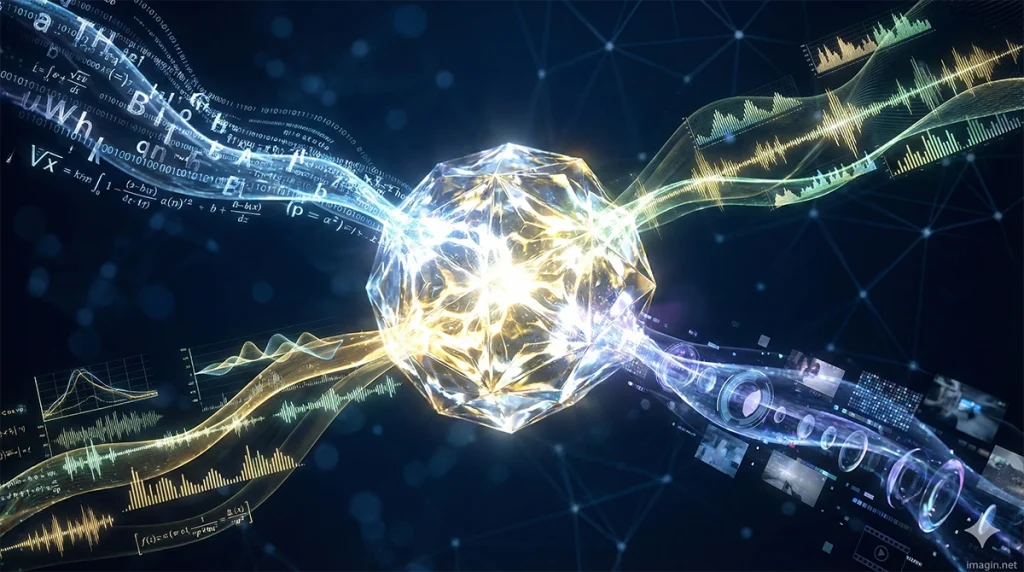
Visual Concept Suggestion: An abstract visualization of a neural network where streams of binary code (text), sound wave patterns (audio), and pixelated light (vision) converge into a glowing, golden core. Set against a deep, cinematic blue background with high-tech metallic accents.
References
- Gemini: A Family of Highly Capable Multimodal Models
- Source: Google DeepMind
- URL: https://deepmind.google/technologies/
- ImageBind: One Embedding Space to Bind Them All
- Source: Meta AI
- URL: https://ai.meta.com/blog/imagebind-six-modalities-binding-ai/