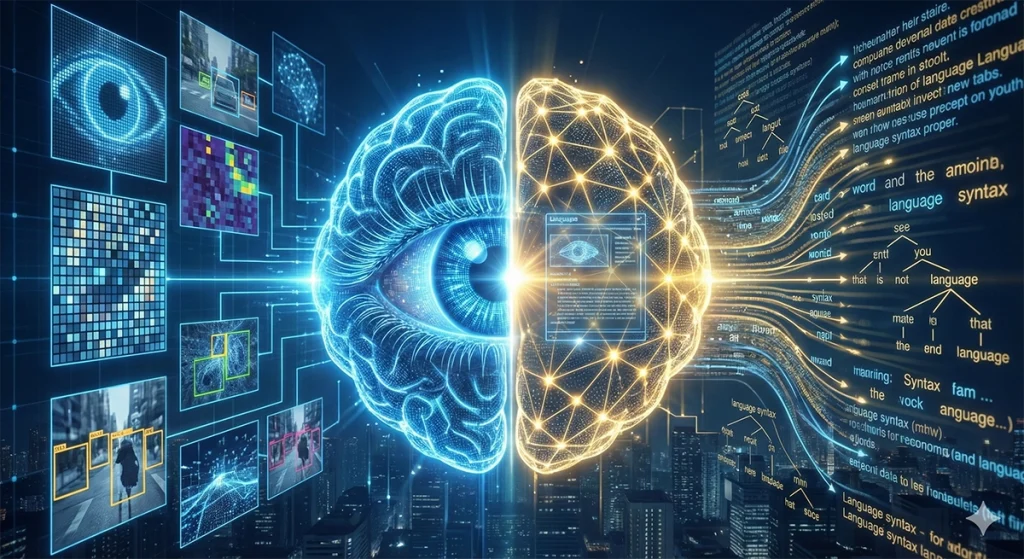
For decades, the fields of Computer Vision (CV) and Natural Language Processing (NLP) existed as distinct kingdoms. Vision researchers focused on pixel matrices and spatial hierarchies, while language experts obsessed over syntax trees and word embeddings. However, in the early 2020s, a profound convergence occurred. The merger of visual perception and linguistic reasoning has given birth to a new era of Multimodal AI, fundamentally changing how machines interact with the human world.
This synergy is not merely about adding a caption to an image. It is about the creation of a “semantic bridge” where pixels and words share a unified understanding of reality.
1. The End of Isolated Intelligence
Classical Computer Vision was remarkably good at identifying objects but notoriously bad at understanding context. A model could identify a “knife” in an image with 99% accuracy, but it couldn’t tell you if that knife was being used to “cut a birthday cake” or if it was part of a “dangerous crime scene.” It lacked the common-sense reasoning inherent in language.
Conversely, early Large Language Models (LLMs) possessed vast knowledge about the world but were “blind.” They could describe a sunset in poetic detail without ever having “seen” the color orange. The synergy between CV and LLMs addresses these gaps, creating a more holistic form of intelligence that can both perceive and reason.
2. CLIP: The Rosetta Stone of Multi-modality
The breakthrough that unified these worlds was CLIP (Contrastive Language-Image Pre-training), introduced by OpenAI in 2021. CLIP changed the paradigm by training on 400 million image-text pairs from the internet.
How the Synergy Works
Instead of training a model to recognize a fixed set of 1,000 categories (the ImageNet approach), CLIP learns to associate images with their natural language descriptions.
- Shared Latent Space: CLIP maps images and text into the same mathematical space. In this space, the vector for a “photo of a cozy fireplace” sits right next to the actual image of a cozy fireplace.
- Zero-shot Capability: Because the model understands concepts through language, it can recognize things it was never explicitly “trained” to see. If it understands the word “astronaut” and the word “underwater,” it can identify an image of an “underwater astronaut” immediately.
3. Vision Transformers Meet the Transformer LLM
The technical alignment of these two fields was accelerated by a shared architecture: the Transformer. When researchers discovered that the same Transformer blocks used for GPT could be applied to image patches (creating Vision Transformers or ViT), the language of vision and the vision of language became computationally identical.
This led to the rise of Vision-Language Models (VLMs) like LLaVA or Flamingo. These models don’t just label an image; they can “talk” about it.
- Visual Question Answering (VQA): You can show the model a picture of your refrigerator and ask, “What can I cook with these ingredients?”
- Reasoning Over Pixels: The model uses the LLM’s reasoning engine to analyze the visual inputs, understanding spatial relationships, cause-and-effect, and even social cues.
4. The Era of GPT-4o and Native Multimodality
We are currently witnessing the shift from “stitched-together” models to Natively Multimodal systems. Previous versions often used a separate vision encoder and a language decoder, leading to a loss of information during translation.
Latest models like GPT-4o (Omni) process text, audio, and vision simultaneously in a single neural network. This allows for:
- Real-time Interaction: The AI can “see” through a smartphone camera and provide live feedback with human-like latency.
- Emotional Intelligence: By analyzing facial expressions (CV) alongside the tone of voice and word choice (NLP/LLM), the synergy enables the AI to perceive human emotions more accurately than ever before.
5. The Future: Embodied AI and AGI
The ultimate destination of this synergy is Embodied AI—robots that can see, understand instructions, and act in the physical world. For a robot to navigate a kitchen and “fetch the blue mug,” it needs the spatial precision of Computer Vision and the linguistic understanding of the LLM to interpret the command.
This integration is a necessary step toward Artificial General Intelligence (AGI). A truly general intelligence cannot be restricted to one modality; it must be able to synthesize information from all sensory inputs to build a coherent model of the world.
Conclusion: A Unified Vision of the Future
The synergy between Computer Vision and Large Language Models represents the fulfillment of a long-held dream in AI research: the creation of a machine that truly “understands.”
By merging the eyes of vision with the mind of language, we have moved beyond simple pattern recognition. We are now building entities capable of observation, reflection, and dialogue. For imagin.net, this transition illustrates that the journey started by ImageNet wasn’t just about pixels—it was about teaching machines the very concepts that define the human experience.
References
- Learning Transferable Visual Models From Natural Language Supervision (CLIP)
- Source: OpenAI (2021)
- URL: https://arxiv.org/abs/2103.00020
- Flamingo: a Visual Language Model for Few-Shot Learning
- Source: DeepMind (NeurIPS 2022)
- URL: https://arxiv.org/abs/2204.14198