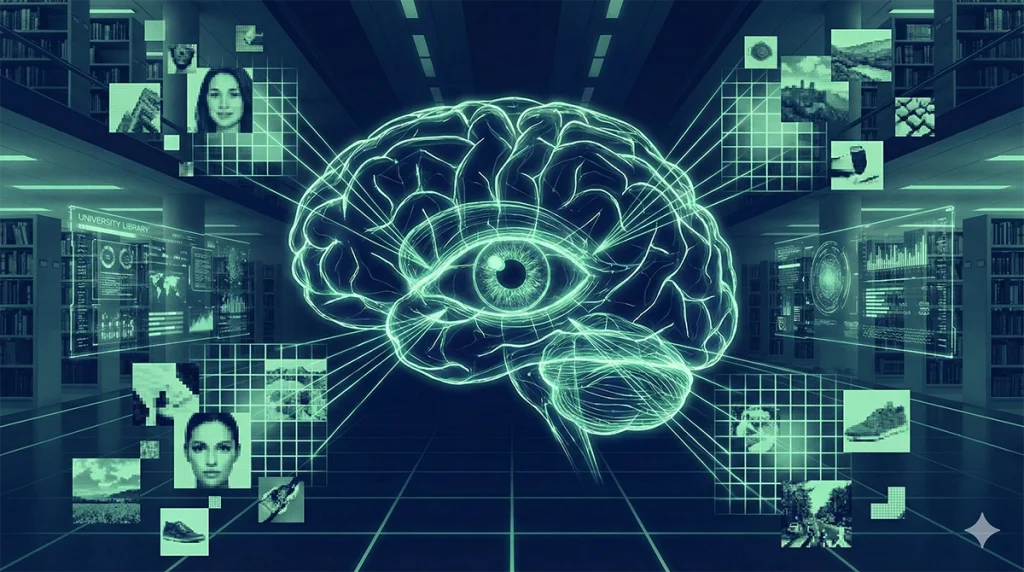
In the history of technology, certain moments act as catalysts that shift the entire trajectory of human progress. For the field of Artificial Intelligence, that moment was not a single line of code or a specific mathematical formula, but a massive collection of data: ImageNet. This article explores the origins, the struggle, and the ultimate triumph of a project that moved AI from the fringes of academic curiosity to the cornerstone of modern civilization.
1. The Paradigm Shift: From Algorithms to Data
Before the mid-2000s, the dominant philosophy in Computer Vision was centered on algorithms. Researchers believed that if they could only design better “rules” or hand-crafted features for a computer to identify edges, textures, and shapes, the machine would eventually “see.”
However, Dr. Fei-Fei Li, then an assistant professor at Princeton and later a professor at Stanford, identified a fundamental flaw in this approach. She realized that the complexity of the world could not be captured by human-written rules. Instead, the problem was a lack of data. If the human brain learns through millions of visual stimuli throughout childhood, a machine would need a Large-scale Dataset to achieve any semblance of visual intelligence.
The Birth of a Visionary Project
In 2006, Li and her team began conceptualizing ImageNet. Their goal was unprecedented: to map the entire “ontology” of the world through images. They utilized WordNet, a hierarchical database of the English language, to structure the dataset. The ambition was to provide thousands of images for each of the 22,000 categories (synsets) within WordNet.
2. The Great Construction: Crowd-Sourcing Intelligence
Building ImageNet was a logistical nightmare. Manually labeling millions of images was an impossible task for a small research team. The project nearly stalled until the team discovered Amazon Mechanical Turk.
By leveraging global crowd-sourcing, Li’s team managed to clean, sort, and label a staggering 14 million images. This process involved:
- Verification: Ensuring each image actually belonged to its assigned category.
- Scale: Managing nearly 50,000 workers from 167 countries.
- Quality Control: Implementing voting mechanisms to ensure labeling accuracy.
By 2009, when the first ImageNet paper was published at the CVPR conference, many in the community remained skeptical. They asked, “Why do we need so much data?” The answer would come three years later.
3. The ILSVRC: A Crucible for Innovation
To encourage the community to utilize this resource, the team launched the ImageNet Large Scale Visual Recognition Challenge (ILSVRC) in 2010. This annual competition provided a benchmark for researchers to test their algorithms on a subset of 1.2 million images across 1,000 classes.
In the first two years, progress was incremental. Most teams used traditional methods like Support Vector Machines (SVMs) and Scale-Invariant Feature Transform (SIFT). The error rates hovered around 25-28%, which, while impressive for the time, was still far from human performance.
4. 2012: The AlexNet Breakthrough
The year 2012 marked the “Big Bang” of modern AI. A team from the University of Toronto, led by Geoffrey Hinton, Alex Krizhevsky, and Ilya Sutskever, entered the competition with a model called AlexNet.
AlexNet was a Convolutional Neural Network (CNN)—a type of Deep Learning architecture that had existed since the 1980s but had been largely ignored due to lack of data and computing power. AlexNet combined three critical elements:
- ImageNet Data: Providing the “fuel” for the model.
- GPU Acceleration: Utilizing Graphics Processing Units to handle the massive parallel computations required by Neural Networks.
- Innovative Architecture: Using “ReLU” activation functions and “Dropout” layers to prevent overfitting.
The Impact of the Result
AlexNet achieved a top-5 error rate of 15.3%, nearly 11 percentage points lower than the runner-up. This margin was unheard of in the scientific community. It was the moment the world realized that Deep Learning was the future.
5. The Ripple Effect: Beyond Image Recognition
The success of AlexNet triggered a gold rush in AI. Within years, error rates on ImageNet dropped below human levels (approximately 5%). This success led to several critical developments:
- Commercial Applications: Technologies like facial recognition in smartphones, autonomous vehicles, and medical image diagnosis all owe their existence to the benchmarks set by ImageNet.
- Transfer Learning: Researchers discovered that a model trained on ImageNet could be “fine-tuned” for other tasks, such as identifying rare diseases in X-rays, even with limited specific data.
- Hardware Evolution: The demand for training large models on ImageNet accelerated the development of specialized AI chips like NVIDIA’s GPUs and Google’s TPUs.
6. Challenges and the Future of Datasets
Despite its success, ImageNet has faced criticism. As the field matured, researchers identified biases within the dataset, including racial and gender stereotypes embedded in the human-labeled tags. This led to a significant “re-balancing” and cleaning effort to ensure the dataset met modern ethical standards.
Today, the focus has shifted from “supervised” learning (where every image is labeled) to self-supervised learning and Multimodal Models like CLIP and GPT-4o, which learn from both text and images across the entire internet. However, ImageNet remains the “North Star” that proved the value of scale.
7. Conclusion: The Legacy of Fei-Fei Li
Fei-Fei Li’s insistence that “the data would change the algorithm” was one of the most prescient insights in the history of science. ImageNet did not just provide a dataset; it provided a culture of benchmarking and a proof of concept for the power of deep neural networks.
As we move toward Artificial General Intelligence (AGI), we must remember that the foundation of today’s “magic” was laid by millions of meticulously labeled images and the vision of a few researchers who believed that to see the world, machines first had to be shown the world.
References
- ImageNet: A Large-Scale Hierarchical Image Database (2009)
- Source: CVPR (Original Paper)
- URL: https://ieeexplore.ieee.org/document/5206848
- ImageNet Large Scale Visual Recognition Challenge (ILSVRC)
- Source: International Journal of Computer Vision
- URL: https://link.springer.com/article/10.1007/s11263-015-0816-y